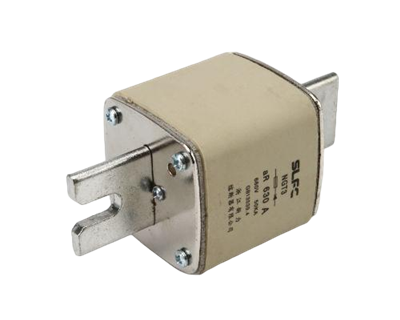
Impedance is a critical electrical parameter that plays a significant role in the performance and safety of electrical circuits. As a leading supplier of NT Fuses, understanding the impedance of NT Fuses is essential for ensuring optimal circuit protection and system efficiency. In this blog post, we will delve into the concept of impedance in NT Fuses, its importance, and how it impacts the overall functionality of electrical systems.
Understanding Impedance
Before we discuss the impedance of NT Fuses, it's important to have a clear understanding of what impedance is. In electrical engineering, impedance (Z) is a measure of the total opposition that a circuit presents to an alternating current (AC). It is a complex quantity that combines resistance (R), inductive reactance (XL), and capacitive reactance (XC). The formula for impedance is given by:
[Z=\sqrt{R^{2}+(X_{L}-X_{C})^{2}}]
Resistance is the opposition to the flow of direct current (DC) and is measured in ohms (Ω). Inductive reactance is the opposition to the change in current flow due to inductance in the circuit, while capacitive reactance is the opposition to the change in voltage due to capacitance.
Impedance in NT Fuses
NT Fuses are high-rupturing capacity (HRC) fuses commonly used in industrial and commercial electrical systems to protect against overcurrent and short-circuit conditions. The impedance of an NT Fuse is an important characteristic that affects its behavior in a circuit.


Resistance Component
The resistance of an NT Fuse is primarily determined by the material and cross-sectional area of the fuse element. A fuse with a higher resistance will dissipate more power as heat when current flows through it. This heat generation is crucial for the operation of the fuse, as it causes the fuse element to melt and break the circuit when the current exceeds the rated value.
Inductive and Capacitive Reactance
In most cases, the inductive and capacitive reactance of NT Fuses is negligible compared to their resistance. NT Fuses are designed to have a low inductance and capacitance to minimize their impact on the circuit's impedance. However, in high-frequency applications or circuits with sensitive components, even small amounts of inductive or capacitive reactance can have a significant effect on the circuit's performance.
Importance of Impedance in NT Fuses
The impedance of NT Fuses has several important implications for the design and operation of electrical systems:
Circuit Protection
The impedance of an NT Fuse affects its ability to protect the circuit from overcurrent and short-circuit conditions. A fuse with the appropriate impedance will respond quickly to excessive current, melting the fuse element and interrupting the circuit before damage occurs. If the impedance is too high, the fuse may not blow fast enough, allowing excessive current to flow and potentially causing damage to the circuit components.
System Efficiency
The impedance of NT Fuses also impacts the overall efficiency of the electrical system. A fuse with a low impedance will have less power loss due to resistance, resulting in lower energy consumption and reduced heat generation. This is particularly important in large-scale industrial applications where energy efficiency is a key consideration.
Compatibility with Other Components
The impedance of NT Fuses must be compatible with the other components in the circuit to ensure proper operation. For example, if the fuse impedance is too high, it may cause voltage drops across the fuse, affecting the performance of other devices in the circuit. On the other hand, if the impedance is too low, it may not provide sufficient protection against overcurrent.
Factors Affecting the Impedance of NT Fuses
Several factors can affect the impedance of NT Fuses:
Fuse Rating
The rated current of an NT Fuse is one of the primary factors that determine its impedance. Generally, fuses with higher current ratings have lower resistance and impedance. This is because a larger cross-sectional area of the fuse element is required to carry the higher current, resulting in lower resistance.
Fuse Material
The material used in the fuse element also affects its impedance. Different materials have different electrical resistivity, which determines the resistance of the fuse. For example, silver has a lower resistivity than copper, so a silver fuse element will have a lower resistance and impedance than a copper fuse element of the same size.
Temperature
The temperature of the fuse can also affect its impedance. As the temperature increases, the resistance of the fuse element generally increases. This is due to the positive temperature coefficient of resistance (PTCR) of most materials. In high-temperature environments, the impedance of the fuse may increase, which can affect its performance.
Measuring the Impedance of NT Fuses
Measuring the impedance of NT Fuses requires specialized equipment and techniques. One common method is to use an impedance analyzer, which can measure the resistance, inductance, and capacitance of the fuse over a range of frequencies. Another method is to use a circuit test setup to measure the voltage and current across the fuse and calculate the impedance using Ohm's law.
Applications of NT Fuses and Their Impedance Considerations
NT Fuses are used in a wide range of applications, each with its own impedance considerations:
Industrial Power Distribution
In industrial power distribution systems, NT Fuses are used to protect transformers, switchgear, and other electrical equipment. The impedance of the fuses must be carefully selected to ensure proper coordination with other protective devices in the system. For example, in a radial distribution system, the fuses should have a low impedance to minimize voltage drops and ensure efficient power transfer.
Motor Protection
NT Fuses are also commonly used to protect motors from overcurrent and short-circuit conditions. The impedance of the fuses should be compatible with the motor's starting and running characteristics. A fuse with too high an impedance may cause the motor to start slowly or not at all, while a fuse with too low an impedance may not provide adequate protection.
Renewable Energy Systems
In renewable energy systems such as solar and wind power plants, NT Fuses are used to protect the inverters, batteries, and other components. The impedance of the fuses must be considered in relation to the high-frequency and variable current characteristics of these systems. For example, in a solar power system, the fuses should have a low impedance to minimize power losses and ensure maximum energy conversion efficiency.
Conclusion
As a supplier of NT Fuses, we understand the importance of impedance in ensuring the proper performance and safety of electrical systems. The impedance of NT Fuses is a complex characteristic that is influenced by several factors, including the fuse rating, material, and temperature. By carefully selecting the appropriate NT Fuses based on their impedance and other electrical characteristics, we can help our customers design and operate efficient and reliable electrical systems.
If you are interested in learning more about NT Fuses and their impedance, or if you have specific requirements for your electrical system, we invite you to contact us for further discussion. Our team of experts is available to provide you with detailed information and assistance in selecting the right NT Fuses for your application.
Related Products
References
- Electrical Engineering Handbook, CRC Press
- Fuse Application Guide, Littelfuse Inc.
- Power System Protection and Switchgear, McGraw-Hill Education