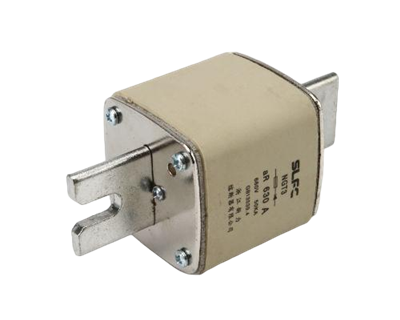
The power factor plays a crucial role in the performance and operation of electrical equipment, including the RT18 - 63 Fuse. As a reliable supplier of RT18 - 63 Fuses, I have witnessed firsthand how the power factor can influence the functionality and lifespan of these fuses. In this blog, we will explore in detail what the power factor is, how it affects the RT18 - 63 Fuse, and why it matters in electrical systems.
Understanding the Power Factor
The power factor (PF) is a measure of how effectively electrical power is being used in an AC (alternating current) circuit. It is defined as the ratio of real power (P) to apparent power (S). Real power is the power that is actually consumed by the load to perform useful work, such as running a motor or lighting a bulb. Apparent power, on the other hand, is the product of the voltage and current in the circuit and represents the total power supplied by the source.


Mathematically, the power factor is expressed as:
[PF=\frac{P}{S}]
The power factor can range from 0 to 1. A power factor of 1 indicates that all the electrical power supplied to the circuit is being used effectively, while a power factor less than 1 means that a portion of the power is being wasted in the form of reactive power. Reactive power is necessary to create and maintain the magnetic fields in inductive loads (such as motors and transformers) and the electric fields in capacitive loads. However, it does not contribute to useful work and can cause additional losses in the electrical system.
The Influence of Power Factor on RT18 - 63 Fuse
1. Current Carrying Capacity
The power factor affects the current flowing through the RT18 - 63 Fuse. In an AC circuit, the current is given by the formula:
[I=\frac{S}{V}=\frac{P}{V\times PF}]
where (I) is the current, (S) is the apparent power, (V) is the voltage, (P) is the real power, and (PF) is the power factor. As the power factor decreases, the current required to deliver the same amount of real power increases. This means that at a low power factor, the RT18 - 63 Fuse may be subjected to higher currents than it would at a high power factor.
If the current exceeds the rated current of the fuse for an extended period, it can cause the fuse element to overheat and eventually blow. Therefore, a low power factor can reduce the effective current - carrying capacity of the RT18 - 63 Fuse and increase the risk of premature fuse operation.
2. Heat Generation
The heat generated in a fuse is proportional to the square of the current flowing through it ((Q = I^{2}Rt), where (Q) is the heat generated, (I) is the current, (R) is the resistance of the fuse element, and (t) is the time). As mentioned earlier, a low power factor leads to an increase in the current. Consequently, the heat generated in the RT18 - 63 Fuse will also increase.
Excessive heat can cause the fuse element to degrade over time, reducing its lifespan. In some cases, the heat can cause the fuse to operate prematurely, even if the current is within its rated value under normal power factor conditions. This can lead to unnecessary downtime in the electrical system and increase maintenance costs.
3. Voltage Drops
In an electrical circuit, the voltage drop across a component is given by (V = IR). When the power factor is low and the current is high, the voltage drop across the RT18 - 63 Fuse will also increase. This voltage drop can affect the performance of other components in the circuit, especially sensitive equipment.
For example, if a motor is connected in the same circuit as the RT18 - 63 Fuse, a large voltage drop across the fuse can cause the motor to receive a lower voltage than it requires. This can result in reduced motor efficiency, increased motor temperature, and even motor failure in severe cases.
Importance of Considering Power Factor in Fuse Selection
When selecting an RT18 - 63 Fuse for an application, it is essential to consider the power factor of the load. If the load has a low power factor, a fuse with a higher current - rating may be required to ensure reliable operation. However, simply increasing the current - rating of the fuse is not always the best solution, as it can also increase the risk of damage to the fuse and other components in the event of a fault.
It is also important to note that power factor correction can be used to improve the power factor of the load. By adding capacitors or other power factor correction devices to the circuit, the reactive power can be reduced, and the power factor can be increased closer to 1. This not only reduces the current flowing through the RT18 - 63 Fuse but also improves the overall efficiency of the electrical system.
Complementary Products: 14*51 Fuse and RT18 - 63 Base
As a supplier of RT18 - 63 Fuses, we also offer complementary products such as the 14*51 Fuse and the RT18 - 63 Base. The 14*51 Fuse is a high - quality fuse that can be used in a variety of applications, providing reliable over - current protection. The RT18 - 63 Base is designed to securely hold the RT18 - 63 Fuse, ensuring proper electrical connection and easy installation and replacement.
Conclusion and Call to Action
In conclusion, the power factor has a significant influence on the performance and operation of the RT18 - 63 Fuse. A low power factor can increase the current, heat generation, and voltage drops, which can lead to premature fuse operation and reduced lifespan. Therefore, it is crucial to consider the power factor when selecting and using RT18 - 63 Fuses in electrical systems.
If you are in need of high - quality RT18 - 63 Fuses, 14*51 Fuses, or RT18 - 63 Bases, or if you have any questions about the power factor and its influence on fuses, please do not hesitate to contact us for further discussions and potential procurement. We are committed to providing you with the best products and technical support to meet your electrical protection needs.
References
- Electric Power Systems, Second Edition by Prabha Kundur
- Electrical Engineering Handbook, Fourth Edition by Richard C. Dorf